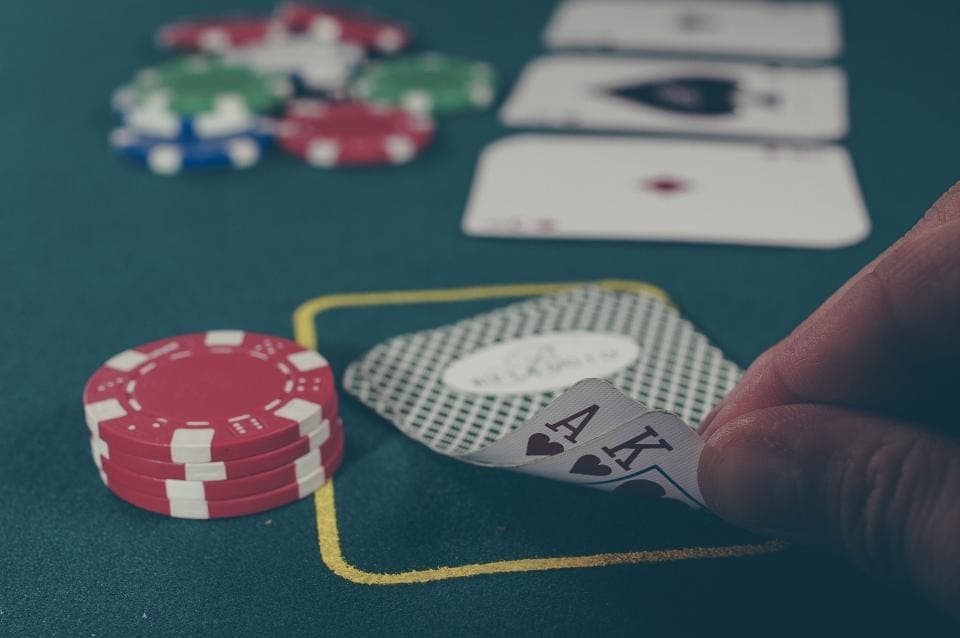
The goal of the game
You play to win chips. Every chip that is bet goes into the pot in the middle of the table, and there are two ways to win it:
- Have the best hand at the showdown. If two or more players are still in after the last round of betting, they show their cards and the best five-card hand takes the pot.
- Be the last player left. If you bet and everyone else folds, you win the pot without showing your cards. That is why bluffing works.
In a match or a tournament you keep playing hands until one player has every chip. At Felt Saga a practice match works this way: a player who runs out of chips is out, and the last one with chips wins.
The button and the blinds
A round disc called the dealer button marks which player is the dealer for the hand. It moves one seat to the left (clockwise) after every hand, so everyone takes a turn.
Before any cards are dealt, the two players to the left of the button put in forced bets called the blinds, so there is always something to play for:
- The small blind is the first player to the left of the button. It is usually half the big blind.
- The big blind is the next player. It is the smallest bet allowed in the hand. With blinds of 10/20, the small blind puts in 10 chips and the big blind 20.
With only two players (heads-up), the button posts the small blind and acts first before the flop, then last on every later round.
In matches and tournaments the blinds go up every few hands or minutes, so the chips keep moving and the game always ends.
How a hand is played
1. The hole cards
Every player gets two cards face down. These are your hole cards, and only you can see them.


2. Betting before the flop
The first player to act is the one to the left of the big blind. Each player in turn can fold, call the big blind, or raise. The action goes round the table until everyone still in has put in the same amount. If nobody raised, the big blind may check or raise; that choice is called the big blind's option.
3. The flop
Three cards are dealt face up in the middle. These are community cards: everyone uses them. A new round of betting starts with the first player still in to the left of the button.


4. The turn
A fourth community card is dealt, followed by another round of betting.
5. The river
The fifth and last community card is dealt, followed by the last round of betting.


6. The showdown
If more than one player is still in after the river betting, the cards are turned over. Each player makes the best five-card hand from their two hole cards and the five community cards. The best hand wins the pot.
Your moves
When it is your turn, you can make one of these moves. What you can do depends on whether someone has bet before you in this round.
- Check
- Pass without betting. Only possible when nobody has bet in this round yet.
- Bet
- Put chips in when nobody has bet yet. The others must then call, raise or fold.
- Call
- Match the biggest bet so far to stay in the hand.
- Raise
- Bet more than the bet before you. In No-Limit Hold'em a raise must be at least as big as the last bet or raise, and there is no upper limit except your chips.
- Fold
- Give up your cards and any chips you have already put in. You are out of the hand until the next one.
- All in
- Bet every chip you have. If you cannot cover a bet, you can still call all in. You can then only win as much from each player as you put in yourself; any extra goes into a side pot for the players with more chips.
The showdown
You can use both of your hole cards, one of them, or none at all: what counts is the best five of the seven cards. When the best hand is on the board itself, everyone still in shares it, and players say "the board plays".
- Hands rank from royal flush down to high card. See the full list in poker hand rankings.
- Suits never decide a winner. When two hands are exactly equal, the pot is split.
- When hands have the same rank, the remaining cards (the kickers) decide. A pair of aces with a king beats a pair of aces with a queen.
An example hand
Six players, blinds 10/20. You are on the button with ace-king. Mika is in the big blind.
- Before the flop: everyone folds to you and you raise to 60. The small blind folds and Mika calls 40 more. The pot is 130 (your 60, Mika's 60 and the 10 the small blind left behind).
- The flop is K♣ 9♦ 4♠. You have top pair with the best kicker. Mika checks, you bet 70, Mika calls. The pot is 270.
- The turn is the 2♥. Mika checks and you check behind.
- The river is the 9♣. Mika bets 150 and you call. The pot is 570.
- Showdown: Mika shows Q♠ 9♠ for three nines. Your two pair, kings and nines, loses.


The river card changed everything. Before it, your kings were ahead; afterwards Mika had three of a kind. That is poker: you can play a hand well and still lose it, and over many hands good decisions win.
Beginner mistakes to avoid
- Playing too many hands. Most starting hands lose money. Fold the weak ones, such as unsuited low cards, especially when you act early.
- Calling too much. If you would not bet a hand, think twice before calling a big bet with it. Raising or folding is often better than calling.
- Ignoring position. Acting last lets you see what others do first. Play more hands on the button and fewer in the blinds and early seats.
- Chasing draws at any price. Only call for a flush or straight when the pot pays enough. The pot odds calculator tells you when it does.
- Bluffing players who always call. A bluff only works against someone who can fold. Against a player who calls everything, bet your good hands instead.
- Missing what the board shows. Four cards of one suit on the board means any player with one card of that suit has a flush.
Poker words to know
- Board
- The five community cards in the middle.
- Draw
- A hand that needs one more card to become strong, such as four cards to a flush.
- Kicker
- A card that does not make the hand but breaks a tie between equal hands.
- Nuts
- The best possible hand on the board at that moment.
- Outs
- The cards still in the deck that would make your hand the winner.
- Position
- Where you sit compared with the button. "In position" means you act after your opponent.
- Pot odds
- The price of a call compared with the size of the pot.
- Stack
- The chips a player has in front of them.
Ready to test yourself? Take the poker quiz, then play a practice match: the computer players will not go easy on you.